What Is a Balance Sheet? A Beginner's Guide for Small Businesses
A balance sheet shows what a business owns, owes and what belongs to the owner. Learn assets, liabilities and equity with a simple small business example.
Quick answer
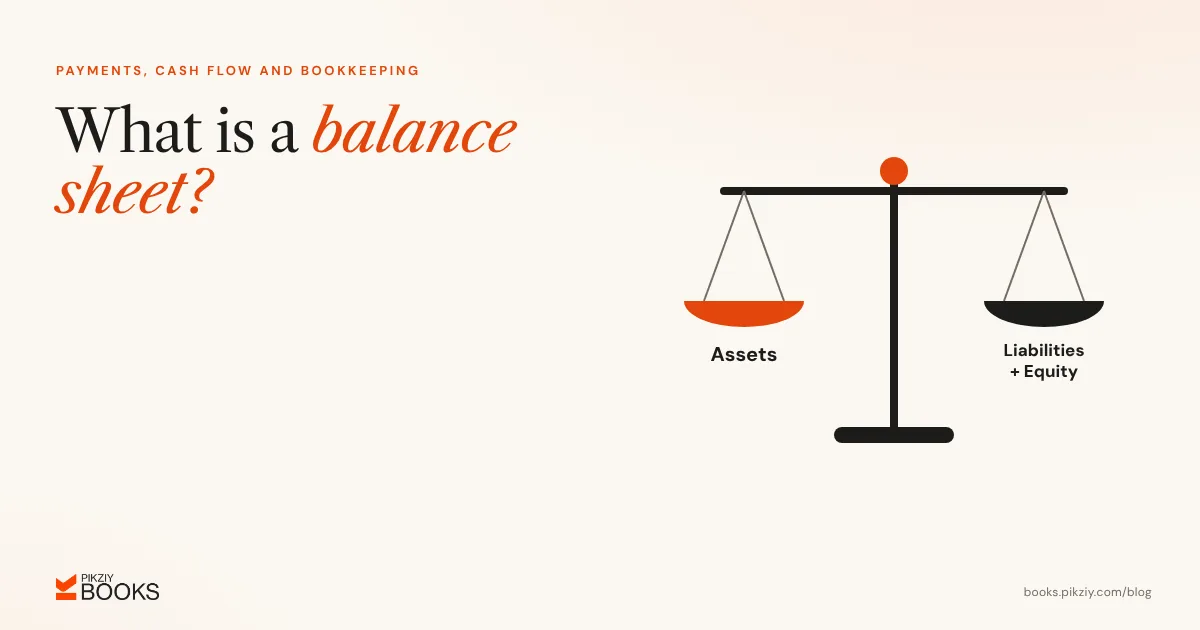
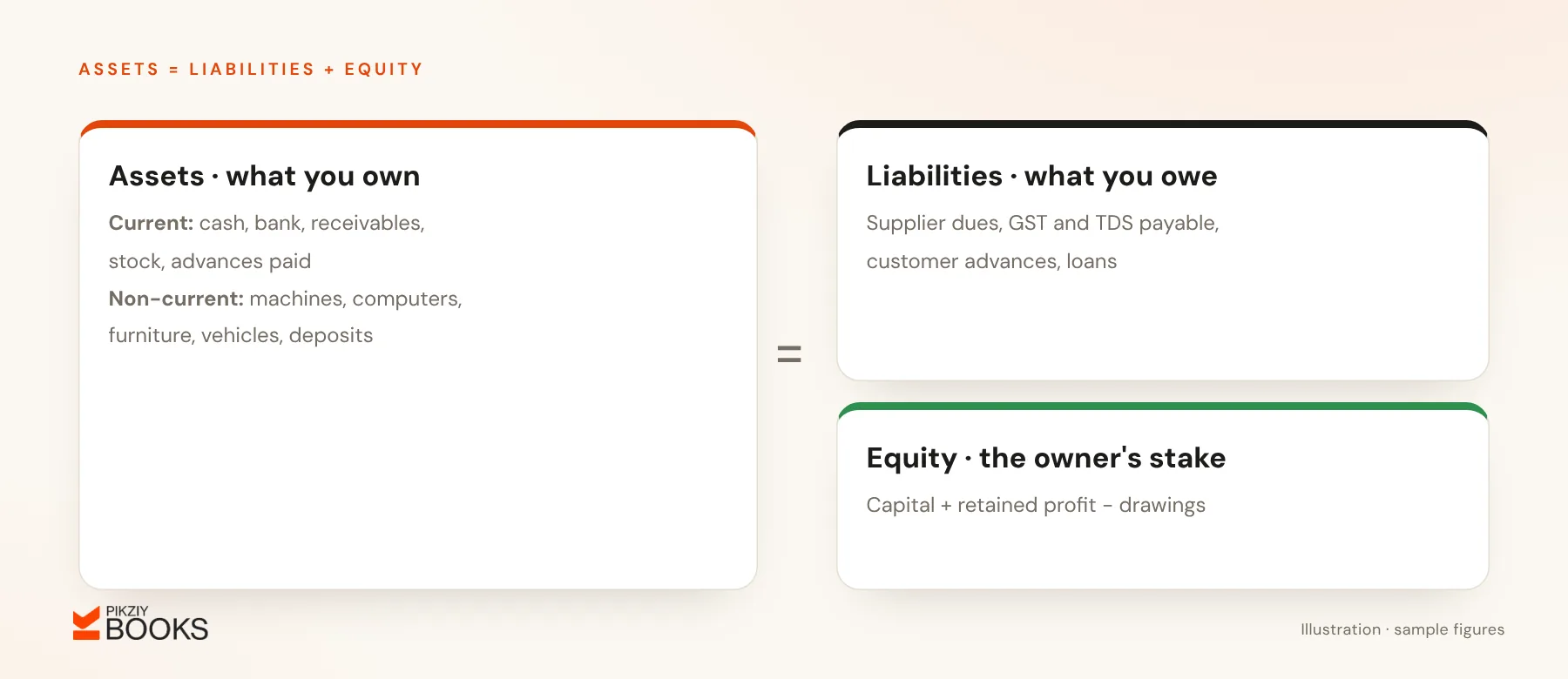
A balance sheet is a snapshot of a business on one date, showing what it owns (assets), what it owes (liabilities) and what belongs to the owners (equity, or capital). It always balances: Assets = Liabilities + Equity.
The three parts
| Part | What it means | Examples |
|---|---|---|
| Current assets | Owned now, turning into cash within a year | Cash, bank balances, receivables, stock, advances paid |
| Non-current assets | Used for more than a year | Equipment, furniture, vehicles, long-term deposits |
| Current liabilities | Owed within a year | Supplier dues, GST payable, TDS payable, short-term loans, advances from customers |
| Non-current liabilities | Owed over more than a year | Long-term loans |
| Equity or capital | The owner's stake | Capital introduced plus accumulated profits, minus drawings |
Sample balance sheet
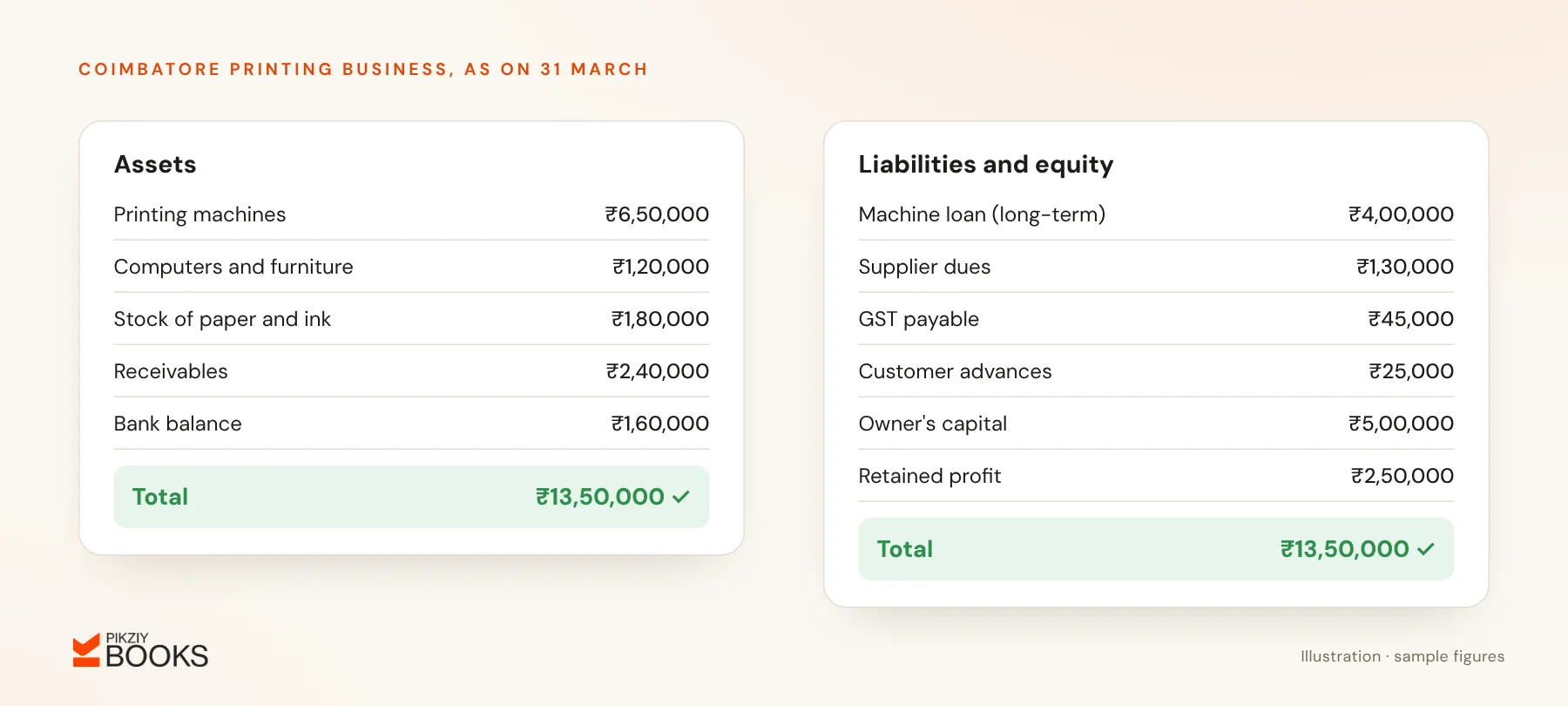
A Coimbatore printing business, as on 31 March:
| Assets | Amount |
|---|---|
| Printing machines | ₹6,50,000 |
| Computers and furniture | ₹1,20,000 |
| Stock of paper and ink | ₹1,80,000 |
| Receivables | ₹2,40,000 |
| Bank balance | ₹1,60,000 |
| Total assets | ₹13,50,000 |
| Liabilities and equity | Amount |
|---|---|
| Machine loan (long-term) | ₹4,00,000 |
| Supplier dues | ₹1,30,000 |
| GST payable | ₹45,000 |
| Advances from customers | ₹25,000 |
| Total liabilities | ₹6,00,000 |
| Owner's capital | ₹5,00,000 |
| Retained profit | ₹2,50,000 |
| Total equity | ₹7,50,000 |
| Liabilities + equity | ₹13,50,000 |
How to read it
- Liquidity: current assets of ₹5,80,000 against current liabilities of ₹2,00,000. A ratio of 2.9 suggests the business can comfortably pay its short-term dues.
- Working capital: current assets minus current liabilities, ₹3,80,000 here.
- Debt: loans compared with equity show how much the business relies on borrowing. Here, ₹4,00,000 of loans against ₹7,50,000 of equity.
Balance sheet vs P&L
The profit and loss statement shows performance over a period. The balance sheet shows the position on one date. The profit from the P&L adds to equity on the balance sheet, which is how the two connect.
Common mistakes
- Mixing personal assets with business assets.
- Forgetting GST and TDS payable.
- Not recording customer advances as liabilities; see advance and partial payments.
Frequently asked questions
Do sole proprietors need a balance sheet?
Why must a balance sheet balance?
Is cash in the bank the same as profit?
How often should I look at the balance sheet?
Next step
List what your business owns and owes today, and check that the difference matches your capital and profits. PikZiy Books keeps double-entry books from every invoice, bill and payment, so your balance sheet is always up to date.