TDS on Freelance and Professional Invoices in India (Updated for the Income-tax Act, 2025)
From April 2026, TDS on professional fees falls under section 393 of the Income-tax Act, 2025. Rates, thresholds, examples and how freelancers claim credit.
Quick answer
TDS on professional fees works like this: when a business pays a resident freelancer or professional for professional services, it usually deducts TDS (tax deducted at source) at 10% once the fees paid to that person in the year cross ₹50,000, and deposits it with the government against the freelancer's PAN. For technical services the rate is generally 2%. From 1 April 2026, these rules sit in section 393 of the Income-tax Act, 2025, which replaced the old section 194J. You claim the deducted amount as tax already paid when you file your income tax return.
What changed in 2026
The Income-tax Act, 2025 came into force on 1 April 2026. It brought the old TDS sections (194C, 194J, 194M and others) together in one section, 393, with a table of payment types, rates and thresholds. It also uses the term “tax year” instead of “previous year”. For freelancers, the practical change is mostly new section and form numbers:
| What | Before April 2026 | From April 2026 |
|---|---|---|
| TDS on professional and technical fees | Section 194J | Section 393(1), table entry 6(iii) |
| TDS on contract work | Section 194C | Section 393(1), table entry 6(i) |
| TDS certificate for non-salary payments | Form 16A | Form 131 |
| Annual tax statement | Form 26AS | Form 168 (alongside AIS) |
Payments made on or before 31 March 2026 stay under the old Act.
Who deducts TDS
- Companies, firms, LLPs and other businesses paying you professional or technical fees.
- Individuals and HUFs whose turnover or receipts put them under tax audit.
- Individuals and HUFs not under audit generally do not deduct TDS on professional fees, unless their payments to one person cross ₹50 lakh in the year. Then they deduct at 2%.
Rates and thresholds for tax year 2026-27
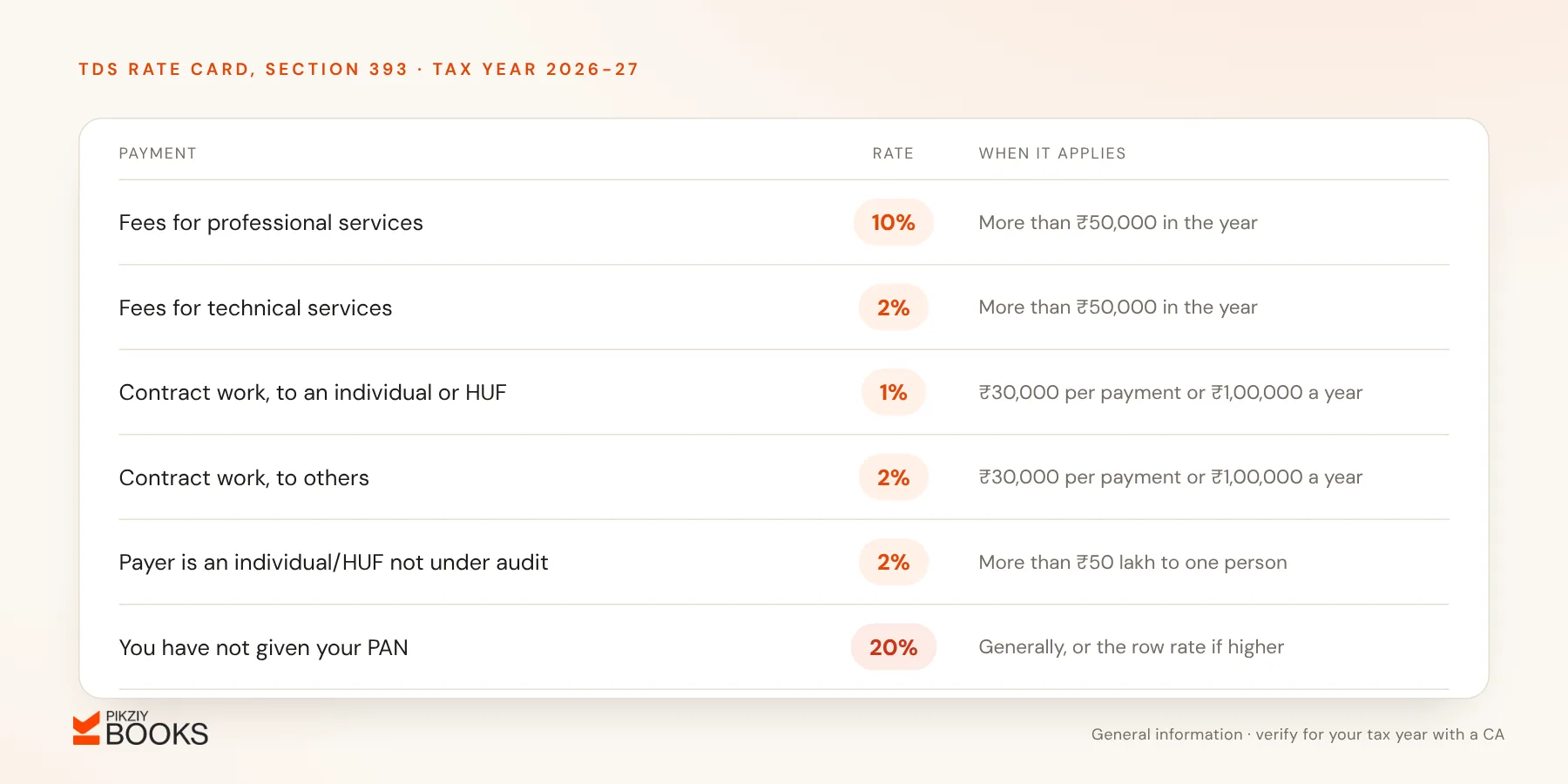
| Payment | Rate | Threshold |
|---|---|---|
| Fees for professional services | 10% | More than ₹50,000 a year to one person |
| Fees for technical services | 2% | More than ₹50,000 a year to one person |
| Contract work (for example printing to order or event management) | 1% to individuals/HUFs, 2% to others | ₹30,000 for a single payment or ₹1,00,000 in the year |
| Paid by an individual/HUF not under audit | 2% | More than ₹50 lakh in the year |
| Payee has not given a PAN | Generally 20%, or the normal rate if higher | — |
Design, consulting, legal, accounting and similar work is usually treated as a professional service at 10%. Whether a particular job is professional, technical or contract work depends on the facts, so check with your client's finance team or your CA if the rate on a payment looks wrong.
Worked example
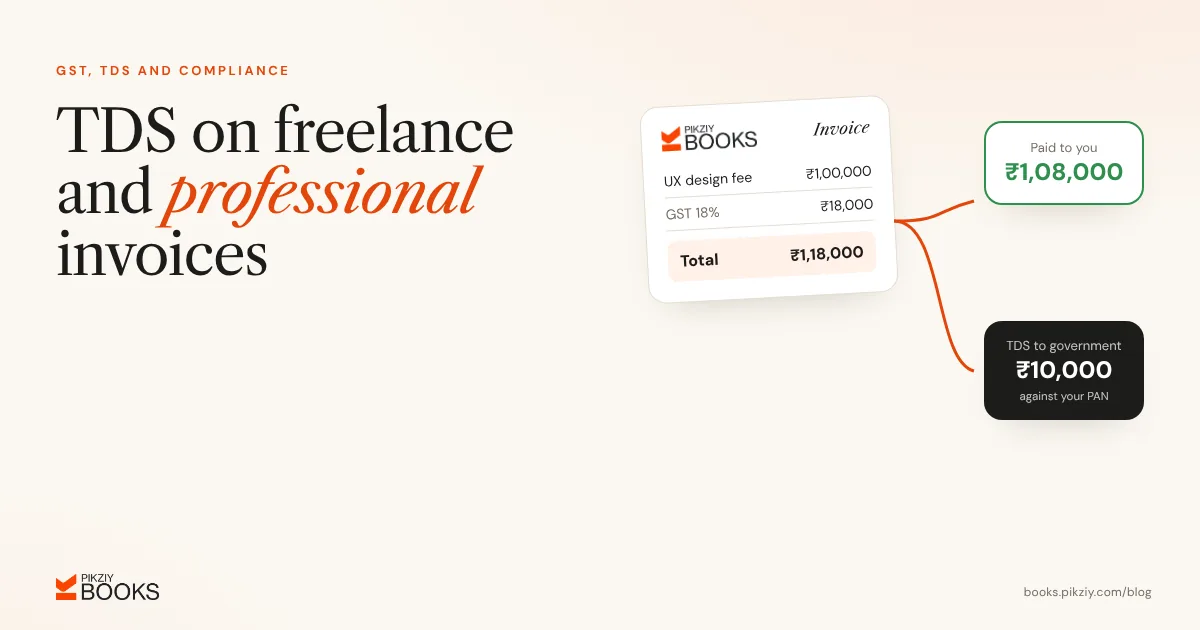
Divya, a freelance UX designer in Pune registered under GST, bills a Mumbai company ₹1,00,000 plus 18% GST.
- Invoice total: ₹1,18,000 (₹1,00,000 + CGST ₹9,000 + SGST ₹9,000).
- Because GST is shown separately, TDS is worked out on the fee alone: 10% of ₹1,00,000 = ₹10,000.
- Amount Divya receives: ₹1,08,000.
- The company deposits ₹10,000 against Divya's PAN. It appears in her Form 168 and AIS, and the company gives her a Form 131 certificate for the quarter.
When she files her income tax return, Divya reports ₹1,00,000 as receipts and claims the ₹10,000 as tax already paid.
What to put on your invoice
- Your PAN, clearly visible.
- The fee and GST shown separately, so TDS is calculated on the fee.
- A line such as “TDS, if applicable, to be deducted on the fee amount (excluding GST) and the certificate shared.”
Our guide to freelance invoices that get paid on time covers the rest of the invoice.
How to track TDS credits
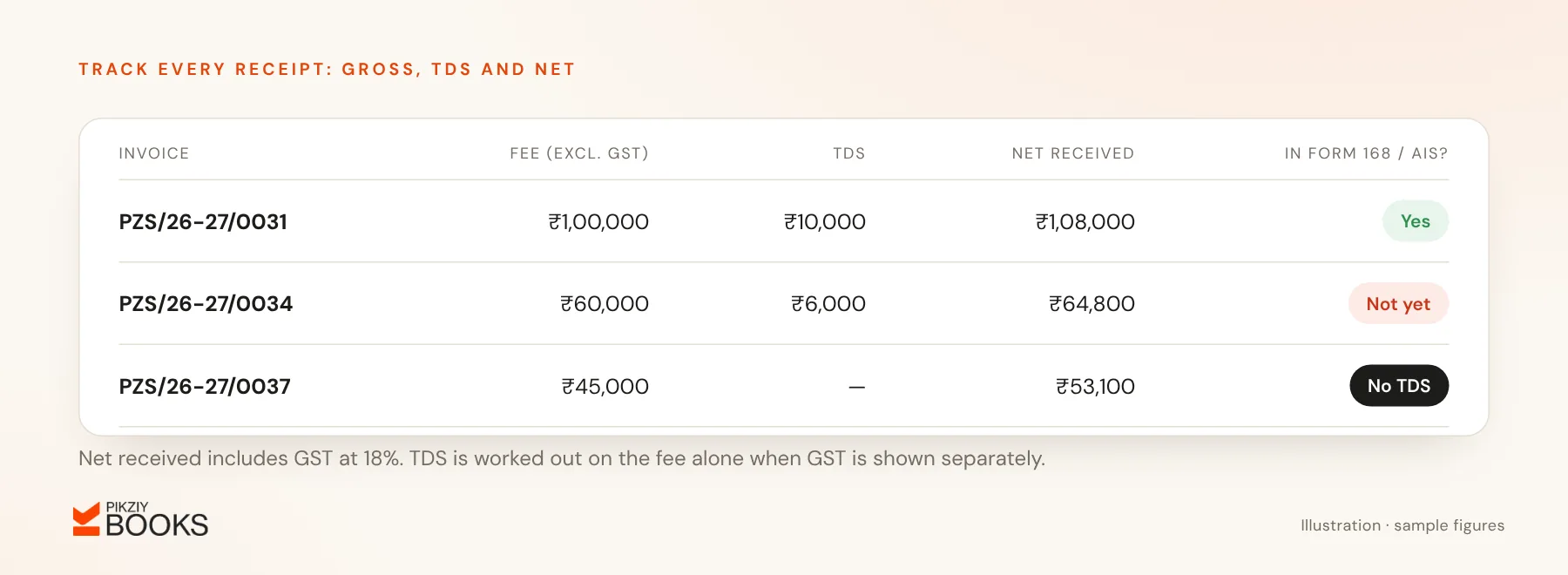
- Record every payment with the gross fee, the TDS deducted and the net amount received.
- Each quarter, check your Form 168 and AIS on the income tax portal for the client's entries.
- If an entry is missing, ask the client to file or correct their TDS return.
- Collect the Form 131 certificate from each client every quarter.
Foreign clients
Clients outside India do not deduct Indian TDS. You receive the full amount, and pay your own tax through advance tax if your total tax for the year is ₹10,000 or more.
Common mistakes
- Not sharing your PAN, which leads to deduction at 20%.
- Recording only the net amount received as income, and forgetting the TDS part.
- Not checking Form 168 or AIS until the filing season.
- Letting a client deduct TDS on the GST amount when GST is shown separately on the invoice.
Frequently asked questions
Is TDS deducted on GST?
Can I get a lower or nil TDS certificate?
Does TDS mean I do not need to pay any more tax?
Is a client's TDS a reason to pay me less than the invoice?
Next step
Add your PAN and a TDS line to your invoice template, and start a simple gross, TDS and net log today. PikZiy Books records TDS against each payment received, so an invoice settled with TDS still shows as fully paid and your TDS total is ready at tax time.