How to Bill Clients for Website Design and Development
How to bill clients for website design and development: scope, advances, milestone invoices, change requests and maintenance retainers, with an example.
Quick answer
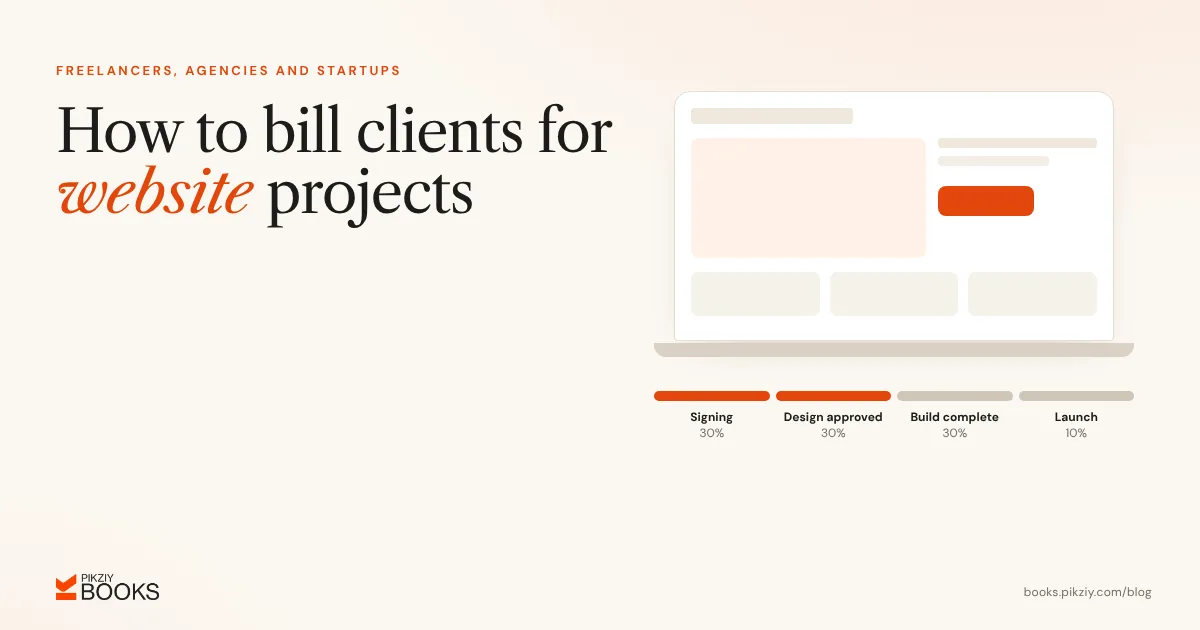
The safest way to bill clients for website design is in milestones tied to deliverables, not dates alone: an advance on signing, a payment on design approval, a payment when development is complete, and the balance at launch. Price change requests separately, and move ongoing support onto a monthly maintenance retainer.
Fix the scope first
Website projects grow when the scope is vague. Agree in writing:
- The number and list of pages or templates.
- Features: forms, booking, payments, blog, multiple languages.
- Who provides content and images, and by when.
- Platforms and third-party costs (domain, hosting, plugins, apps), and who pays for them.
- Revision rounds at the design stage.
- Browser and device testing.
- What happens after launch, including a warranty period for bug fixes.
A milestone payment schedule
A common structure for a ₹1,50,000 project:
| Milestone | Share | Amount | What it covers |
|---|---|---|---|
| Signing | 30% | ₹45,000 | Books your time and covers discovery |
| Design approval | 30% | ₹45,000 | Home and inner page designs signed off |
| Development complete | 30% | ₹45,000 | Staging site ready for review |
| Launch | 10% | ₹15,000 | Site live and handed over |
Worked invoice schedule
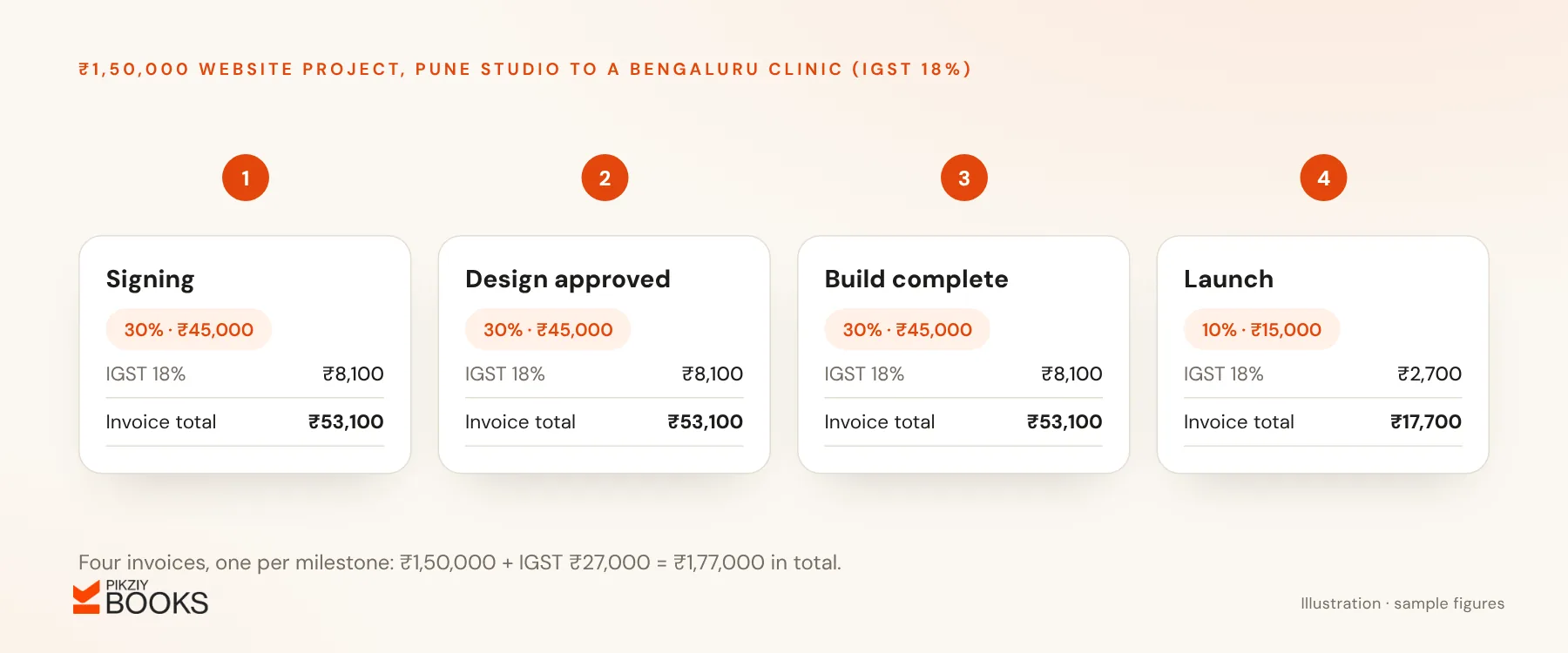
A Pune web studio, GST-registered in Maharashtra, builds a site for a clinic in Bengaluru, Karnataka. The price is ₹1,50,000 plus GST. Because the client is in another state, each invoice carries IGST at 18% (see CGST, SGST and IGST explained).
| Invoice | Fee | IGST 18% | Total |
|---|---|---|---|
| 1. Signing | ₹45,000 | ₹8,100 | ₹53,100 |
| 2. Design approved | ₹45,000 | ₹8,100 | ₹53,100 |
| 3. Development complete | ₹45,000 | ₹8,100 | ₹53,100 |
| 4. Launch | ₹15,000 | ₹2,700 | ₹17,700 |
| Total | ₹1,50,000 | ₹27,000 | ₹1,77,000 |
Each invoice describes the milestone, for example “Milestone 2 of 4: UI design approved for 8 page templates (SAC 998314)”. A clear line like this is what gets invoices approved quickly by a client's accounts team.
Third-party costs
Domains, premium themes, paid plugins and app subscriptions are best bought in the client's name, with the client's card. If you buy them on the client's behalf, decide whether you are passing on the exact cost as a reimbursement (a “pure agent” arrangement, which has specific conditions under GST) or reselling with a margin, and invoice accordingly. Ask your CA which treatment fits your case.
Change requests
- Confirm in writing that the request is outside the agreed scope.
- Quote the extra price and the effect on the timeline.
- Get approval before you start.
- Bill it as a separate line or invoice.
After launch: maintenance retainers
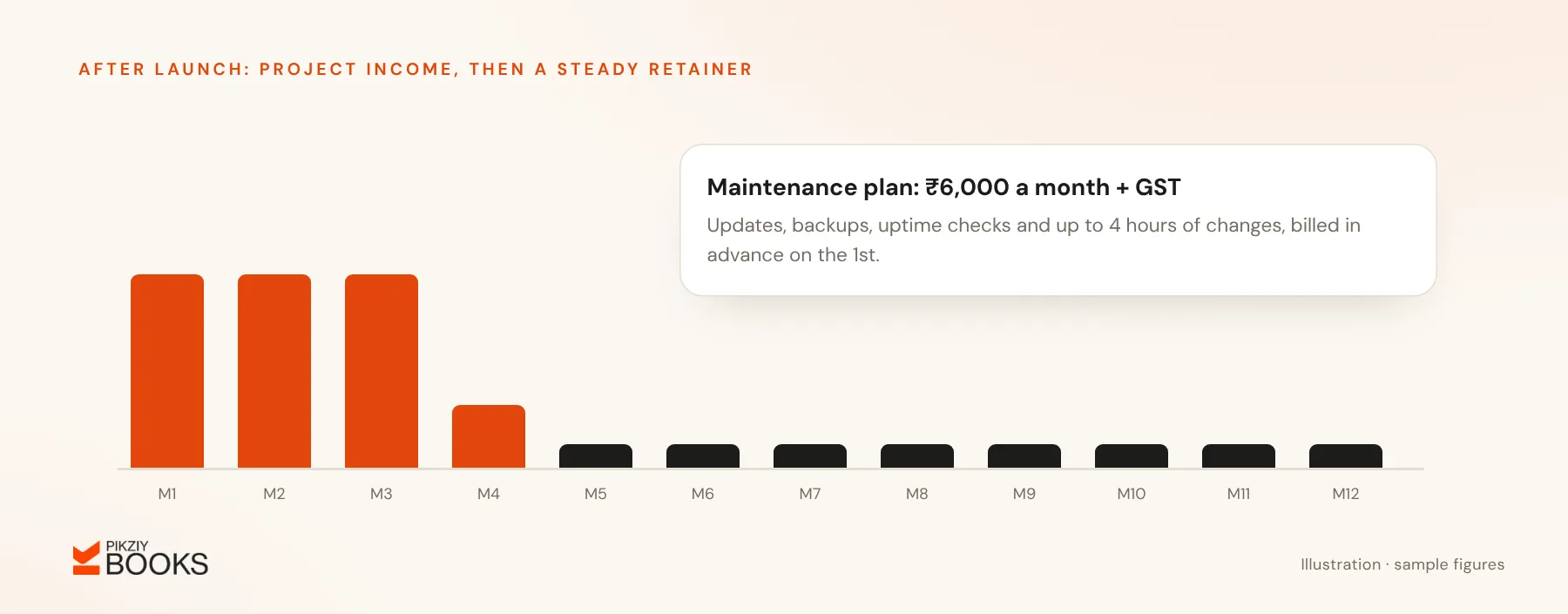
Offer a monthly plan covering updates, backups, small content changes and uptime checks. Example: ₹6,000 a month plus GST for up to 4 hours of changes, billed in advance. This turns one-off projects into predictable income; see how to manage monthly retainers and recurring invoices.
Common mistakes
- A large final payment, which clients delay because the site is already live.
- Starting development before design sign-off.
- Absorbing small “can you just” changes until they add up to days.
- Paying for client subscriptions on your own card without a reimbursement agreement.
Frequently asked questions
Should I hand over the site before the final payment?
How long should the warranty period be?
Which SAC code applies to website development?
Can I bill the first milestone before starting work?
Next step
Rewrite your next website proposal with four milestones and a change-request rule. PikZiy Books lets you split a project into milestone invoices from one quotation and shows which milestones are billed, paid and still to come.