How to Manage Freelance Income and Expenses in India
A simple monthly system to manage freelance income and expenses in India: separate accounts, income and TDS, expenses, a tax set-aside and a monthly review.
Quick answer
Managing freelance income and expenses takes five habits: keep a separate bank account for freelance work, record every invoice and payment (with any TDS), log expenses with receipts as they happen, set aside a fixed share of each payment for tax, and review your numbers once a month. A spreadsheet is enough to start; software helps once clients and invoices multiply.
Step 1: separate business and personal money
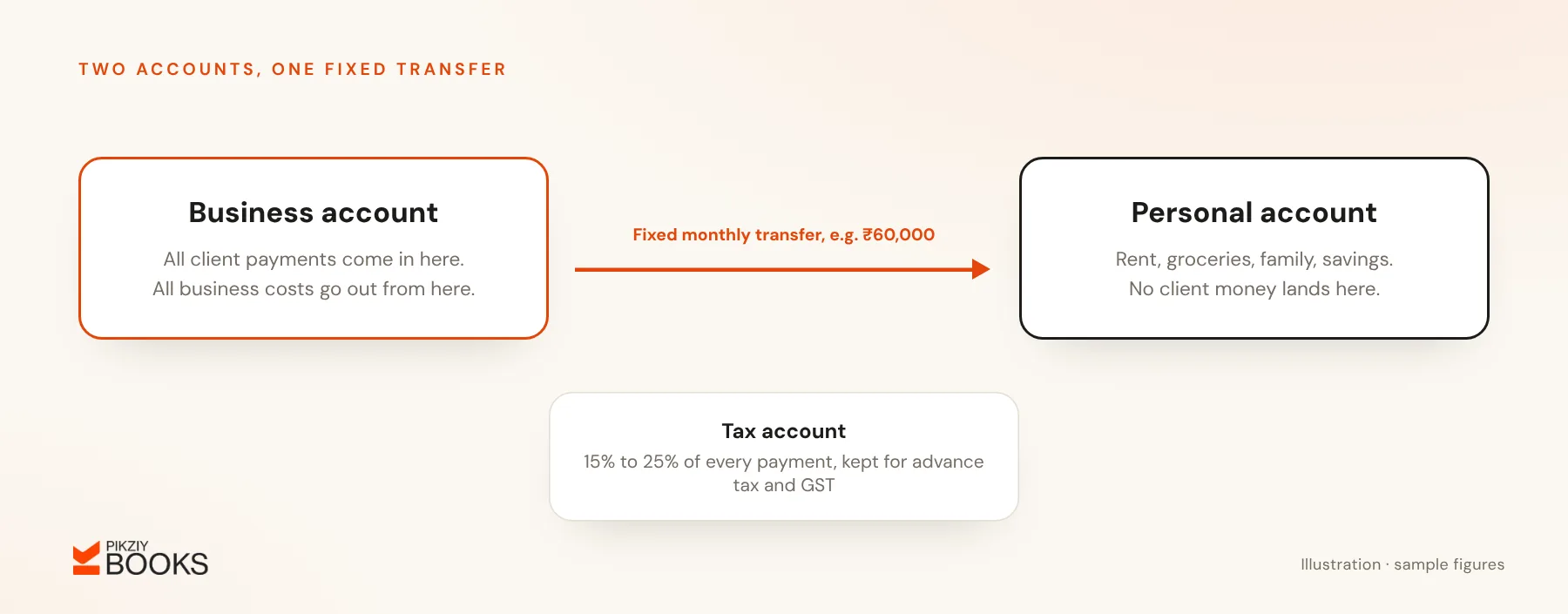
Open an account used only for client payments and business expenses. Pay yourself a fixed amount from it each month, as if it were a salary. This makes tax time far easier, shows you what the business really earns, and stops business costs disappearing into personal spending.
Step 2: record income properly
For each invoice, record:
- Invoice number, client and date.
- Fee amount, and GST if you are registered.
- TDS deducted by the client.
- Net amount received, and the date.
Your gross fees, not just what landed in your bank, are your receipts for income tax. The TDS part is tax already paid on your behalf, which you claim when you file. Our guide to TDS on professional fees explains how to check it.
Step 3: track expenses as they happen
Common freelance business expenses include:
- Laptop, monitor and other equipment.
- Software subscriptions and cloud storage.
- Internet and mobile bills (the business share).
- Coworking, or a share of home office costs.
- Travel to client meetings.
- Professional courses and books.
- Accounting and legal fees.
Photograph or forward every receipt the same day. Waiting until March means lost receipts.
Step 4: set aside money for tax
A simple rule: move 15% to 25% of each payment into a separate tax account, depending on your income and the tax regime you choose. Use it for advance tax and any GST you owe. Advance tax is due if your tax for the year, after TDS, is ₹10,000 or more.
| Advance tax due date | Paid by then (cumulative) |
|---|---|
| 15 June | 15% of the year's tax |
| 15 September | 45% |
| 15 December | 75% |
| 15 March | 100% |
If you opt for the presumptive scheme below, you can generally pay the whole amount in one instalment by 15 March.
Step 5: review monthly
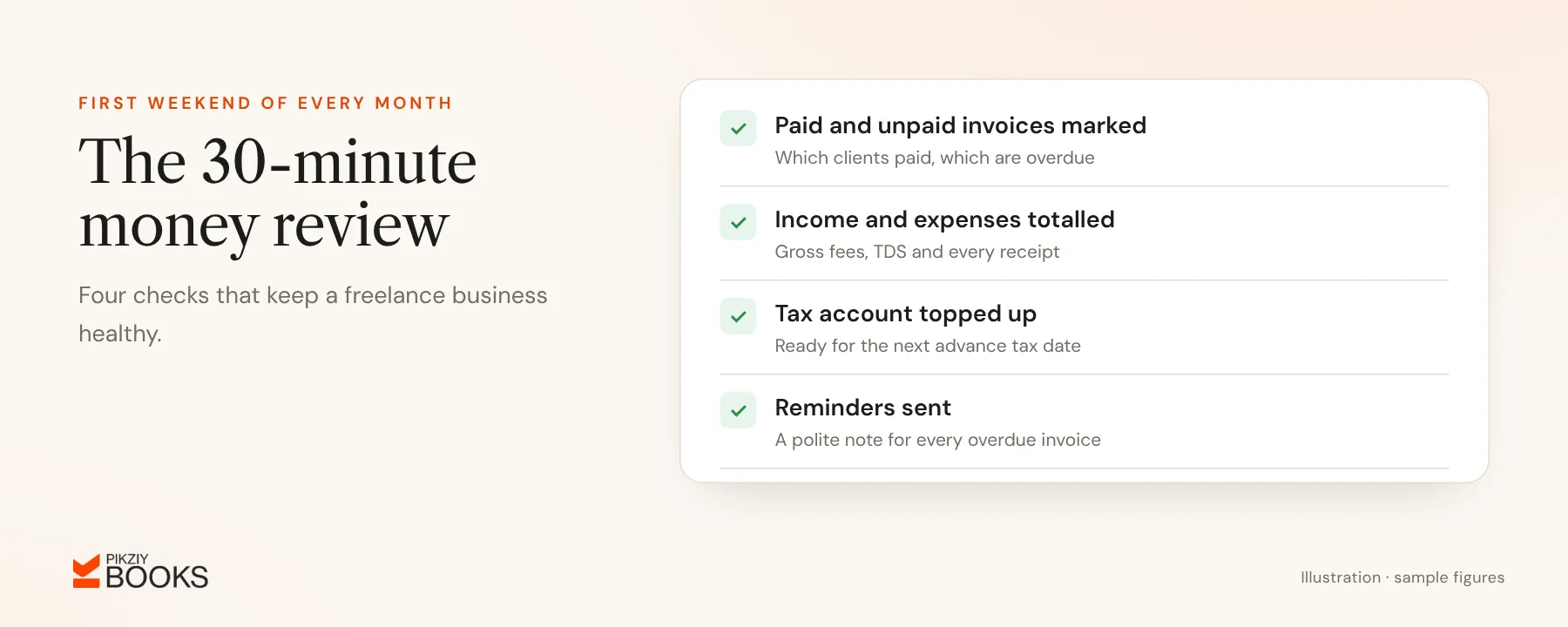
- Mark which invoices were paid and which are overdue.
- Total income and expenses for the month.
- Check your tax account balance.
- Send reminders for overdue invoices; see how to get freelance invoices paid on time.
Worked example
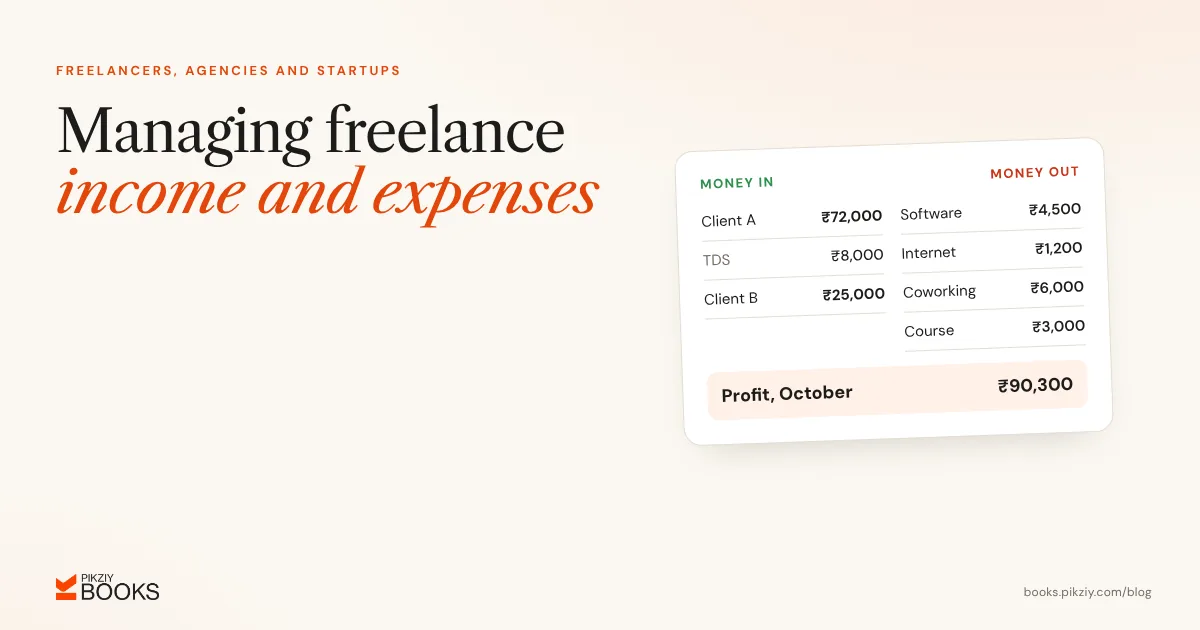
Sameer, a freelance developer in Ahmedabad, is not GST-registered. His October:
| Amount | |
|---|---|
| Client A: invoiced ₹80,000, TDS ₹8,000, received ₹72,000 | ₹80,000 |
| Client B (an individual): no TDS | ₹25,000 |
| Gross receipts | ₹1,05,000 |
| Expenses: software ₹4,500, internet ₹1,200, coworking ₹6,000, course ₹3,000 | − ₹14,700 |
| Profit before tax | ₹90,300 |
| Tax already deducted (TDS) | ₹8,000 |
| Set aside: 20% of the ₹97,000 received | ₹19,400 |
Sameer can now see that his real monthly profit is about ₹90,000, not the ₹97,000 that hit his bank, and that ₹8,000 of tax is already credited to his PAN.
Presumptive taxation for professionals
Resident professionals can opt for presumptive taxation under section 58 of the Income-tax Act, 2025 (the old section 44ADA). If your gross receipts are up to ₹50 lakh, or up to ₹75 lakh when cash receipts are no more than 5% of the total, 50% of receipts is treated as your income and you do not need to keep detailed books. You can declare a higher profit if it is higher. Keep tracking expenses anyway, so you know whether the scheme actually helps you, and ask your CA which option suits you.
Common mistakes
- Treating the net amount received as your total income.
- No tax set-aside, then a large bill in March.
- Losing receipts.
- Paying personal costs from the business account without recording them.
Frequently asked questions
Do freelancers need to keep books of accounts?
Can I claim my phone bill as a business expense?
Should I pay myself a salary?
Do I need GST registration to track expenses?
Next step
Open a separate account this week and start a simple income and expenses sheet. PikZiy Books records each invoice with its GST and TDS, logs expenses against receipts and shows your monthly profit without a spreadsheet.