How to Handle Advance Payments and Partial Payments
How to handle advance and partial payments: request advances, issue receipt vouchers, adjust advances on the final invoice and record part payments.
Quick answer
To handle advance and partial payments, agree the advance percentage upfront and record it against the client. If you are GST-registered and supplying services, issue a receipt voucher and pay GST on the advance. On the final invoice, show the full value and deduct the advance. For part payments, record each amount against its invoice and keep the balance open until it is fully paid.
Why advances matter
An advance confirms the client's commitment and reduces your risk. Common levels are 30% to 50% for projects, and 100% upfront for small jobs and retainers.
GST on advances
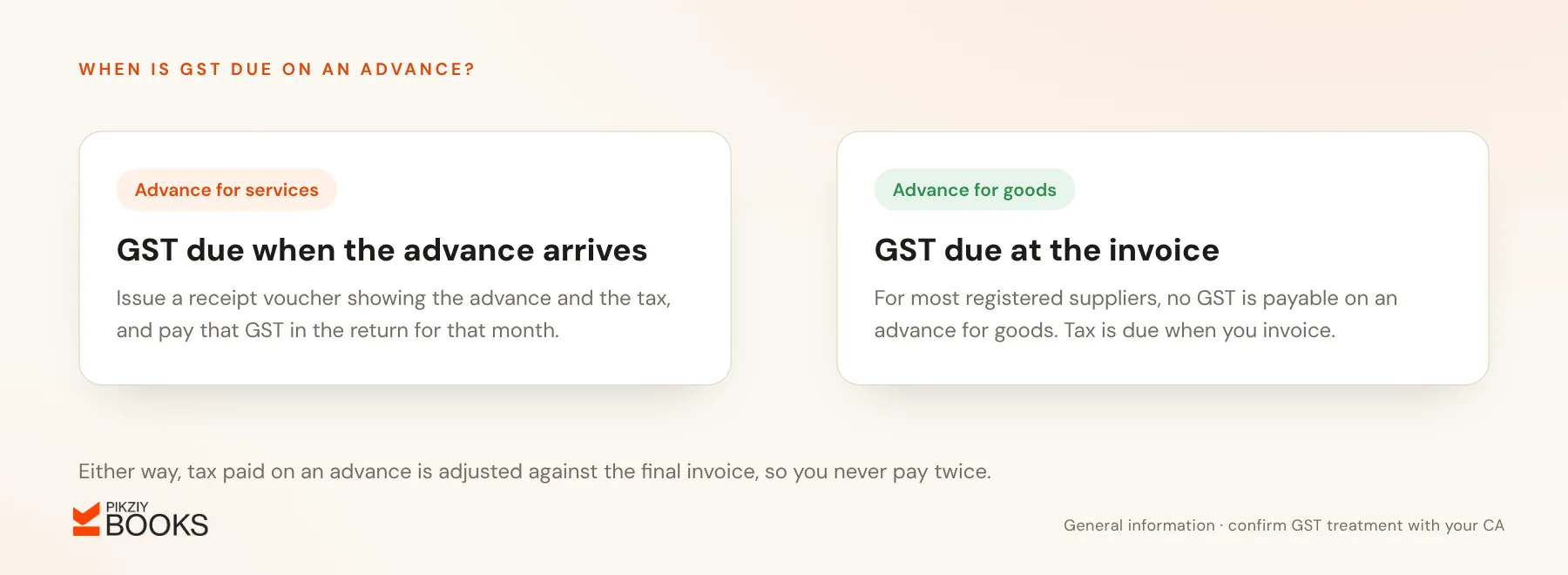
- Services: GST is payable when you receive an advance. Issue a receipt voucher showing the advance and the tax, and pay that tax in the return for that month.
- Goods: for most registered suppliers, GST is not payable on advances for goods; it is due when you issue the invoice.
When the final invoice is raised, tax already paid on the advance is adjusted, so you do not pay it twice.
Worked example: an advance for services
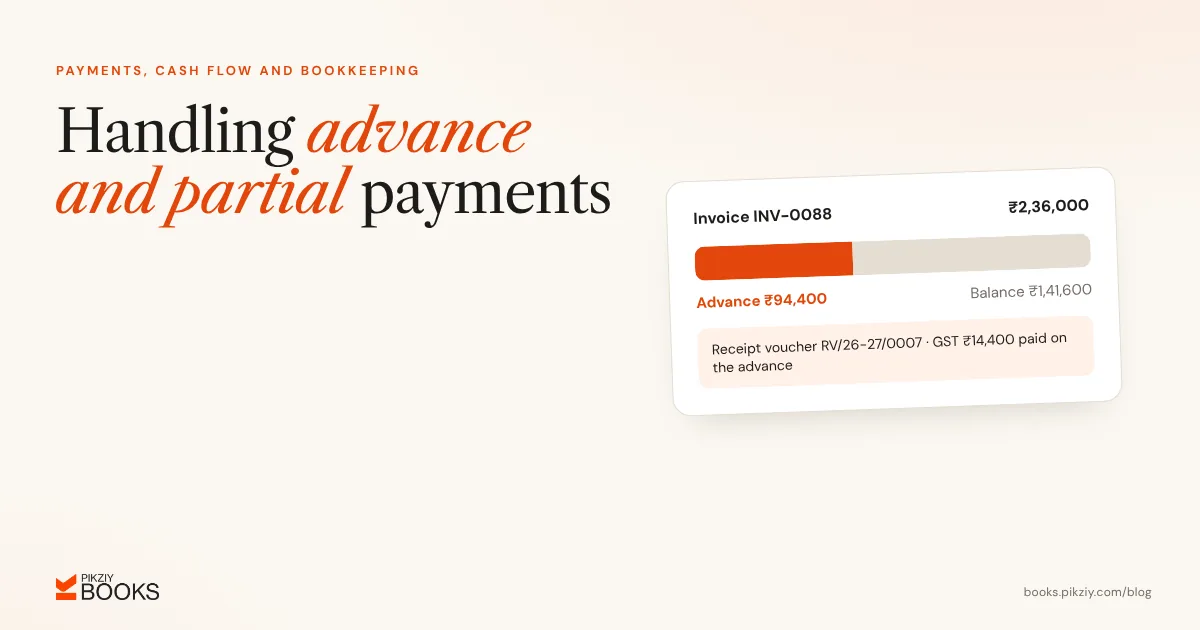
A Mumbai events agency agrees ₹2,00,000 plus 18% GST with a Mumbai client and asks for a 40% advance. Both are in Maharashtra, so CGST and SGST apply.
| Step | Amount |
|---|---|
| Advance received (including GST) | ₹94,400 |
| of which taxable value | ₹80,000 |
| of which GST, paid in that month's return | ₹14,400 |
| Final tax invoice after the event: ₹2,00,000 + GST ₹36,000 | ₹2,36,000 |
| Less: advance received | − ₹94,400 |
| Balance payable by the client | ₹1,41,600 |
| GST still to pay on the final invoice (₹36,000 − ₹14,400) | ₹21,600 |
Partial payments
When a client pays part of an invoice:
- Record the amount and date against that invoice number.
- Issue a receipt showing the amount received and the balance; see invoice vs receipt.
- Keep the invoice in your receivables until the balance is cleared.
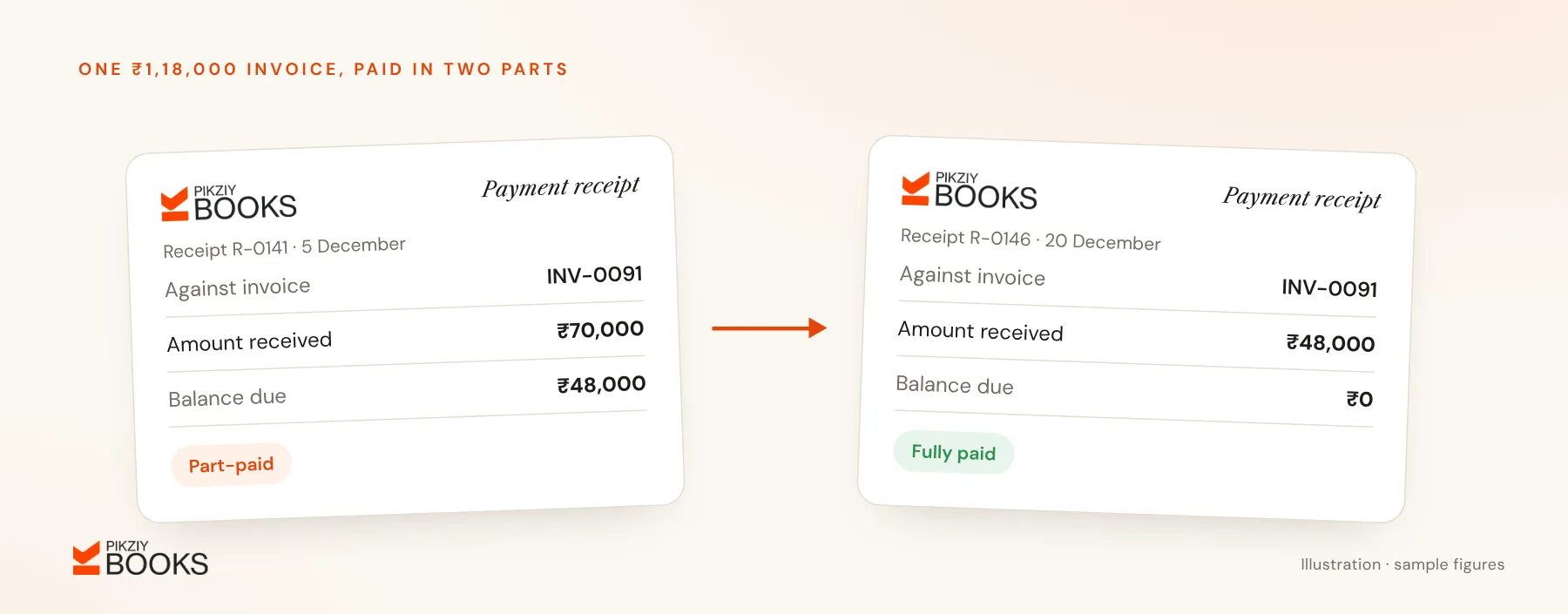
Example: an invoice for ₹1,18,000. The client pays ₹70,000 on 5 December and ₹48,000 on 20 December. Two receipts; the final balance is ₹0.
When TDS reduces the payment
If the client deducts TDS, the shortfall is not a part payment. Record it as tax deducted and treat the invoice as settled once the credit shows in your annual tax statement (Form 168). See TDS on professional fees.
Refunding an advance
If the project is cancelled, issue a refund voucher for the advance you return, and adjust the GST you paid on it as the rules allow. Ask your CA how to report it in your returns.
Common mistakes
- Not paying GST on advances for services.
- Showing only the balance on the final invoice, instead of the full value less the advance.
- Applying a part payment to the wrong invoice.
- Treating TDS as an unpaid balance.
Frequently asked questions
Should the advance be shown on the final invoice?
Do I need a proforma invoice to request an advance?
What is a receipt voucher?
Can I ask for an advance from a foreign client?
Next step
Put your advance percentage and payment schedule in every quotation from now on. PikZiy Books records advances and part payments against the right invoice and shows the balance due on every receipt.