GST Invoice Format in India: Mandatory Fields, Rules and Examples
The complete GST invoice format under Rule 46: every mandatory field, B2B vs B2C rules, HSN/SAC digits, time limits and a worked example you can follow.
Quick answer
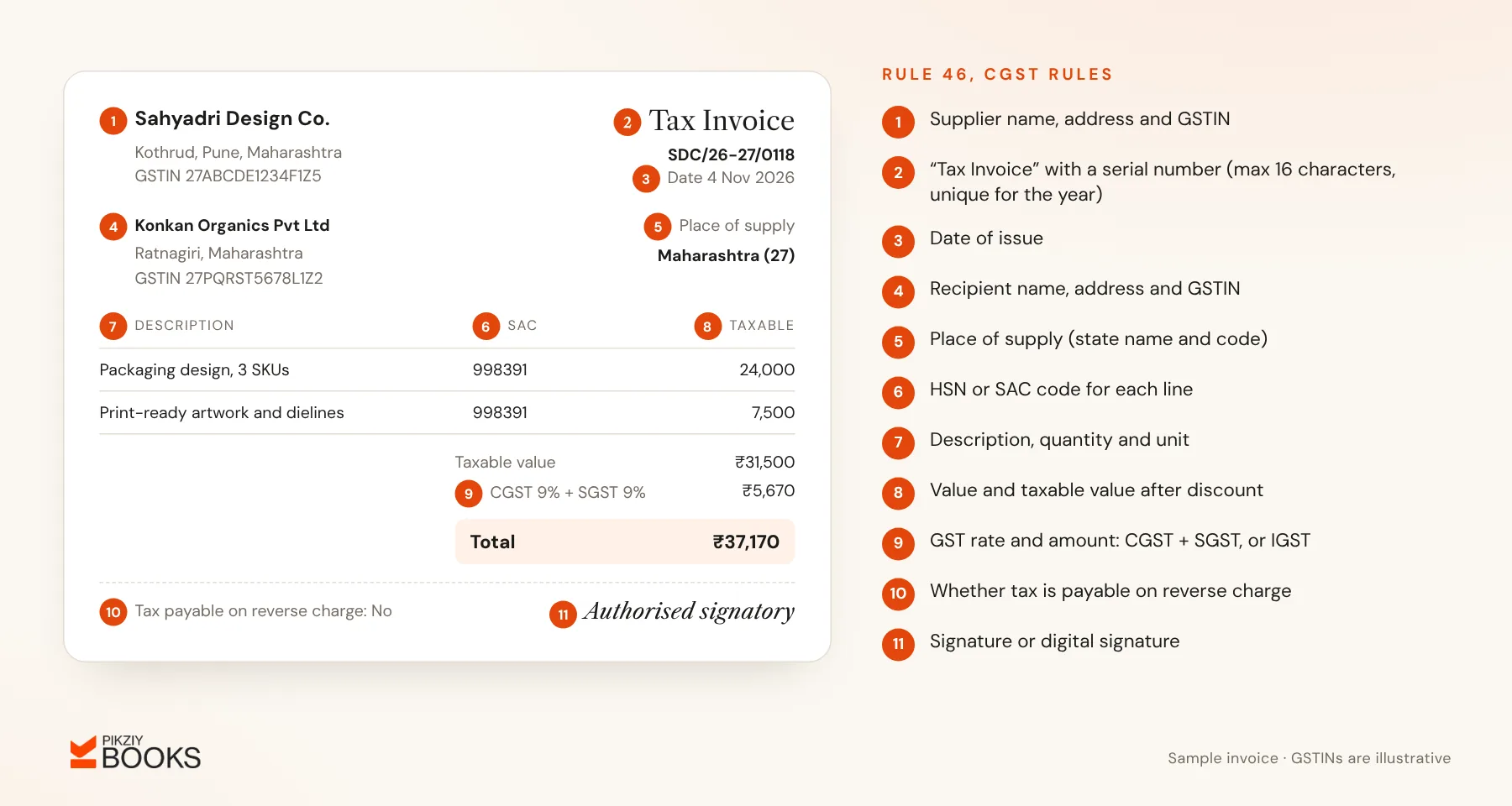
The GST invoice format is set by Rule 46 of the CGST Rules. A tax invoice must show the supplier's name, address and GSTIN; a unique serial number; the date; the recipient's details (and GSTIN if they are registered); the HSN or SAC code; a description, quantity and value for each line; the taxable value; the GST rate and amount split into CGST and SGST (or UTGST), or IGST; the place of supply; whether tax is payable on reverse charge; and a signature.
Who must issue a tax invoice
Every GST-registered supplier making a taxable supply must issue a tax invoice. Two groups issue a bill of supply instead: composition taxpayers, and suppliers of exempt goods or services. A business that is not registered cannot issue a tax invoice or charge GST at all; see how to invoice without GST registration.
The mandatory fields
Here is every field Rule 46 asks for, grouped the way they usually appear on the page.
| Section | What to include |
|---|---|
| Supplier | Name, address and GSTIN |
| Invoice details | The words “Tax Invoice”, a consecutive serial number of up to 16 characters that is unique for the financial year, and the date of issue |
| Recipient | Name, address and GSTIN (or UIN) if registered. For an unregistered buyer with a taxable value of ₹50,000 or more: name, address, and the state name and code |
| Delivery | Delivery address, if different from the place of supply |
| Items | HSN code for goods or SAC for services, description, quantity and unit (for goods), total value, discount and taxable value |
| Tax | Rate and amount of CGST and SGST/UTGST for intra-state supplies, or IGST for inter-state supplies |
| Place of supply | State name (and code), required for inter-state supplies and good practice on every invoice |
| Reverse charge | Whether tax is payable on reverse charge |
| Authentication | Signature or digital signature of the supplier or an authorised person |
Your invoice number format has its own rules. Our guide to invoice numbering in India covers prefixes, the 16-character limit and restarting in April.
How many HSN or SAC digits to show
- Aggregate turnover up to ₹5 crore in the previous year: at least a 4-digit HSN or SAC on B2B invoices. It is optional on B2C invoices.
- Aggregate turnover above ₹5 crore: a 6-digit code on every invoice.
- Services use SAC codes, which start with 99 and usually run to 6 digits.
Not sure which code applies? Read HSN vs SAC codes.
Current GST rates in brief
Since 22 September 2025, the main GST slabs are 0%, 5%, 18% and 40%, with special rates for a few items such as gold. The old 12% and 28% slabs were folded into these. Most professional and business services, including design, consulting and software development, are taxed at 18%. Check the current rate notification for your exact goods or service before you update your invoice template.
Time limits for issuing an invoice
- Goods: at or before removal or delivery.
- Services: within 30 days of supplying the service (45 days for banks and certain financial institutions).
- Continuous supplies: as per the payment schedule or milestones in the contract.
Worked example: B2B, same state
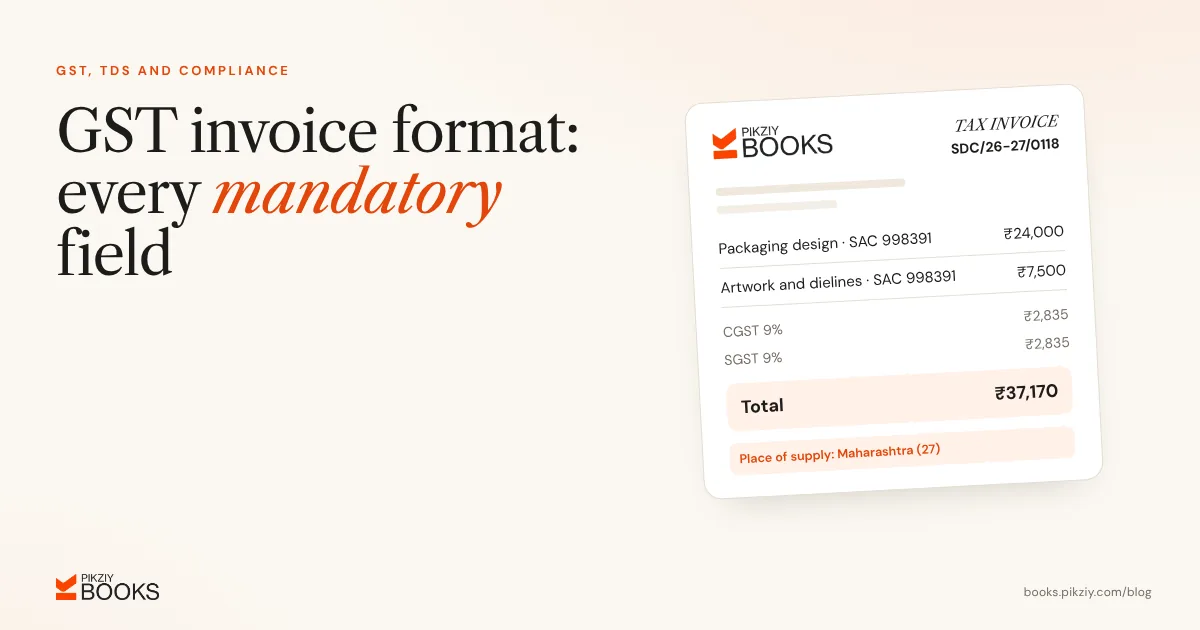
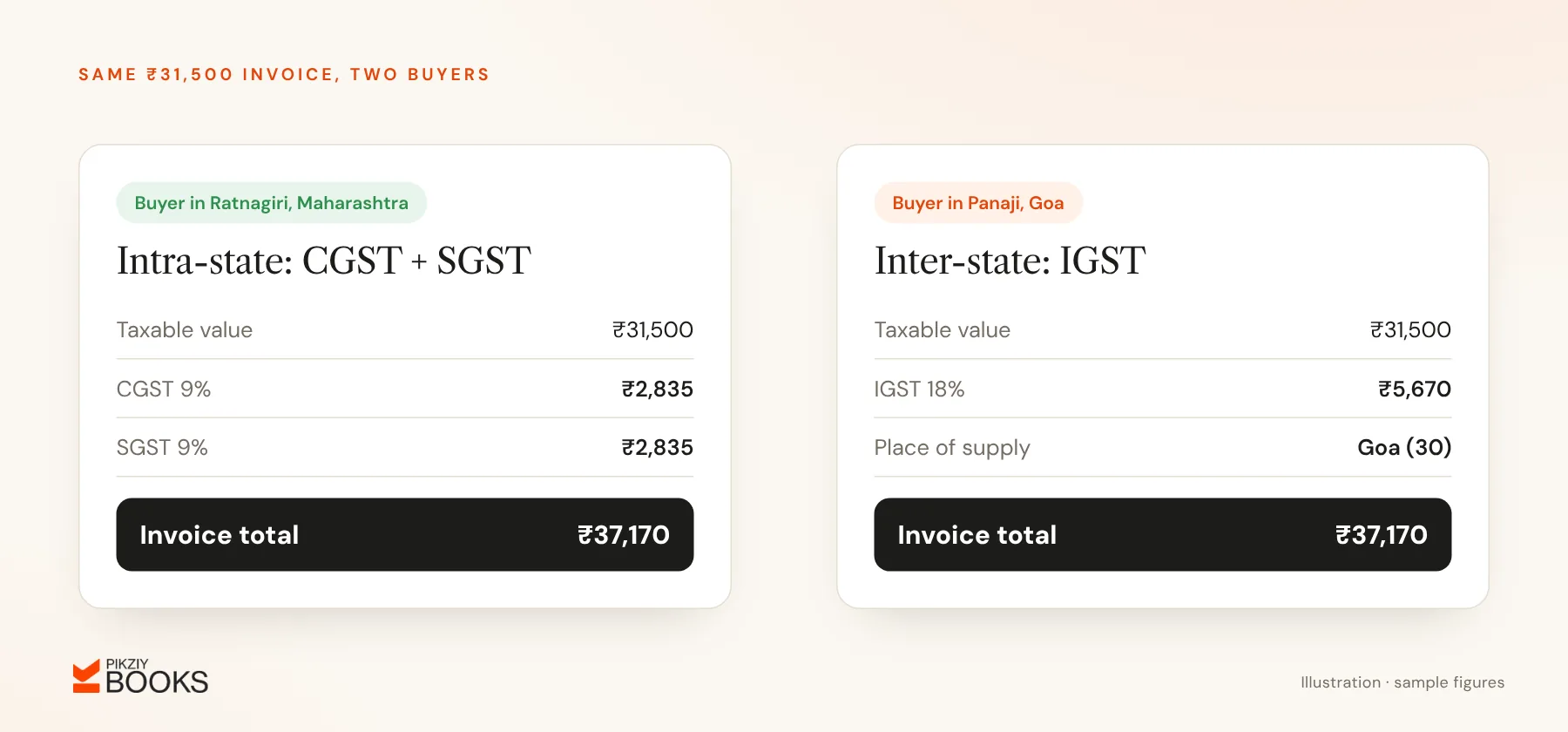
Sahyadri Design Co. in Pune bills Konkan Organics Pvt Ltd in Ratnagiri for packaging work. Both are in Maharashtra, so the place of supply is Maharashtra (27) and the tax is split into CGST and SGST.
| Line | SAC | Amount |
|---|---|---|
| Packaging design, 3 SKUs | 998391 | ₹24,000 |
| Print-ready artwork and dielines | 998391 | ₹7,500 |
| Taxable value | ₹31,500 | |
| CGST 9% | ₹2,835 | |
| SGST 9% | ₹2,835 | |
| Total | ₹37,170 |
Worked example: B2B, another state
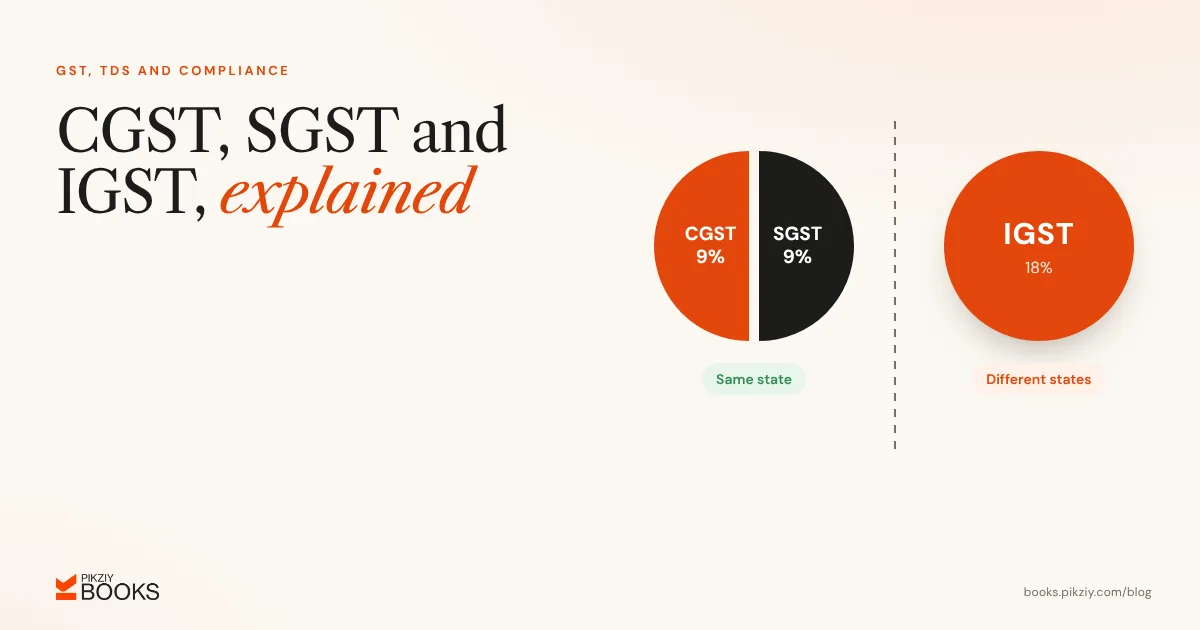
If the same client were in Goa (state code 30), the place of supply would be Goa. The supplier charges IGST at 18% on ₹31,500, which is ₹5,670, giving the same total of ₹37,170. Only the type of tax changes, never the total. CGST, SGST and IGST explained goes into this in detail.
B2C invoices
For sales to consumers, you issue a tax invoice without the buyer's GSTIN. If the taxable value is ₹50,000 or more, add the buyer's name, address and state. Retailers can issue one consolidated tax invoice at the end of the day for B2C sales below ₹200 each, where the buyer does not ask for an invoice.
Copies of the invoice
- Goods: three copies: original for the recipient, duplicate for the transporter, triplicate for the supplier.
- Services: two copies: original for the recipient, duplicate for the supplier.
E-invoicing
If your aggregate turnover crossed ₹5 crore in any financial year from 2017-18, your B2B invoices must be e-invoices: the invoice data is uploaded to the Invoice Registration Portal (IRP), which returns an IRN and a QR code to print on the invoice. Businesses with turnover of ₹10 crore or more must report each invoice within 30 days of its date. Check whether you are covered each year.
Common mistakes
- Missing the place of supply on inter-state invoices.
- Typos in a B2B client's GSTIN, so the client cannot see the invoice in their GSTR-2B.
- Using an old rate after a rate change, such as 12% after September 2025.
- Leaving out the reverse charge declaration.
- Invoice numbers longer than 16 characters.
For a longer checklist, see 15 common invoice mistakes.
Frequently asked questions
Is a digital signature mandatory on a GST invoice?
Can I issue a GST invoice in a foreign currency?
Does a GST invoice need a logo?
Is “Tax Invoice” written on top mandatory?
Next step
Turn the field list above into a template once, and use it for every invoice. PikZiy Books lays out each mandatory field for you, numbers invoices automatically and splits CGST, SGST and IGST from the place of supply.