How to Categorise Business Expenses Correctly
Categorise business expenses correctly: direct vs indirect, capital vs revenue, and the categories every small business needs, with Indian examples.
Quick answer
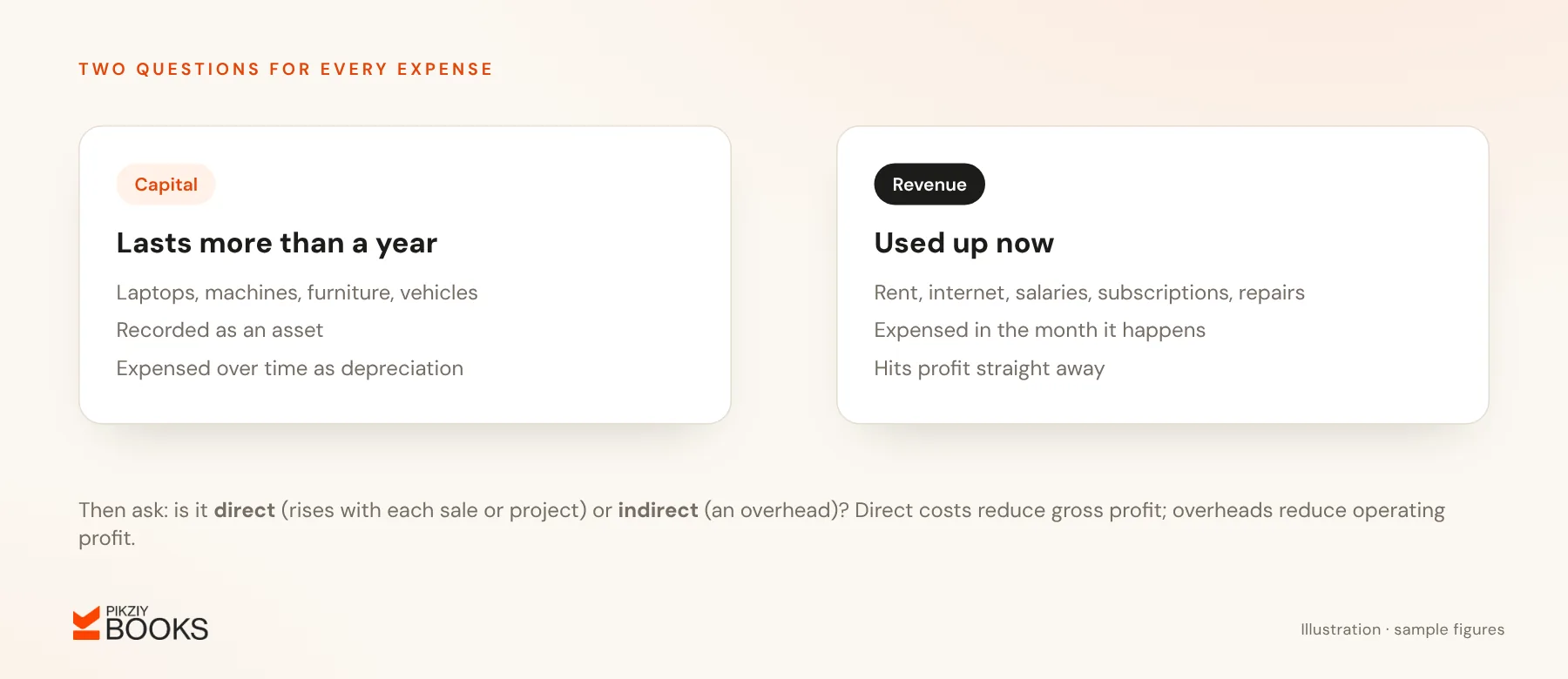
To categorise business expenses, ask two questions about each one. Is it capital (an asset that lasts more than a year, such as a laptop) or revenue (a running cost, such as internet)? And is it direct (tied to producing what you sell) or indirect (an overhead)? Then file it in a consistent category such as rent, software, travel or salaries.
Capital vs revenue expenditure
- Capital: creates an asset used over several years. Examples: laptops, machines, furniture, vehicles, and sometimes website development. Recorded as an asset and expensed over time through depreciation.
- Revenue: used up in the normal course of business. Examples: rent, electricity, salaries, subscriptions, repairs. Expensed in the period.
Direct vs indirect expenses
- Direct: costs that rise with each sale or project, such as raw materials, packaging, freelancers on a project, or printing for a client job.
- Indirect (overheads): costs of running the business, such as rent, admin salaries, accounting fees and office internet.
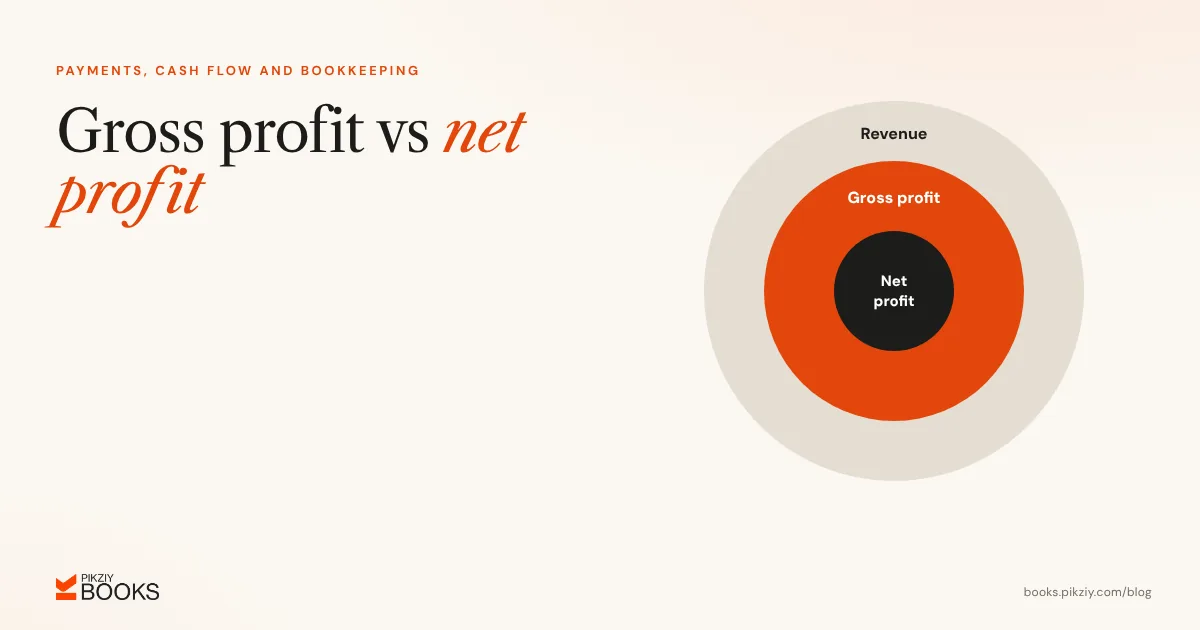
Direct costs reduce gross profit; indirect costs reduce operating profit. See how to create a profit and loss statement.
Suggested categories for a small business
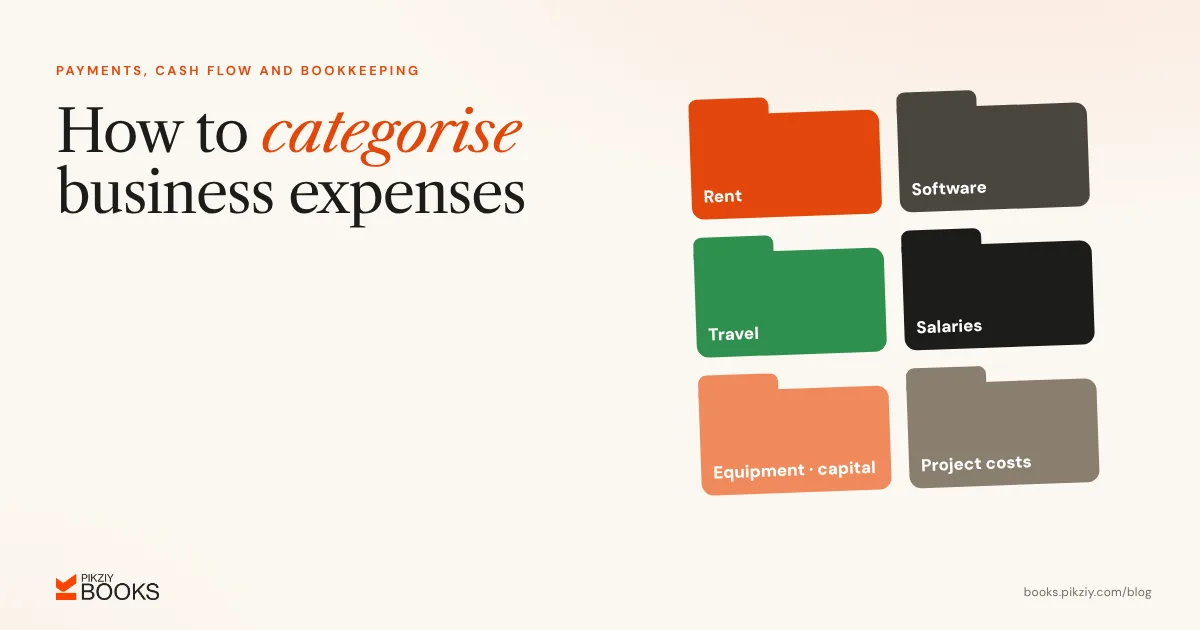
- Cost of goods, or direct project costs
- Salaries and wages
- Rent and maintenance
- Utilities and internet
- Software and subscriptions
- Marketing and advertising
- Travel and conveyance
- Professional fees (CA, legal)
- Bank charges
- Office supplies
- Repairs
- Insurance
- Training
- Depreciation (calculated, not paid)
Worked examples
| Expense | Capital or revenue | Direct or indirect | Category |
|---|---|---|---|
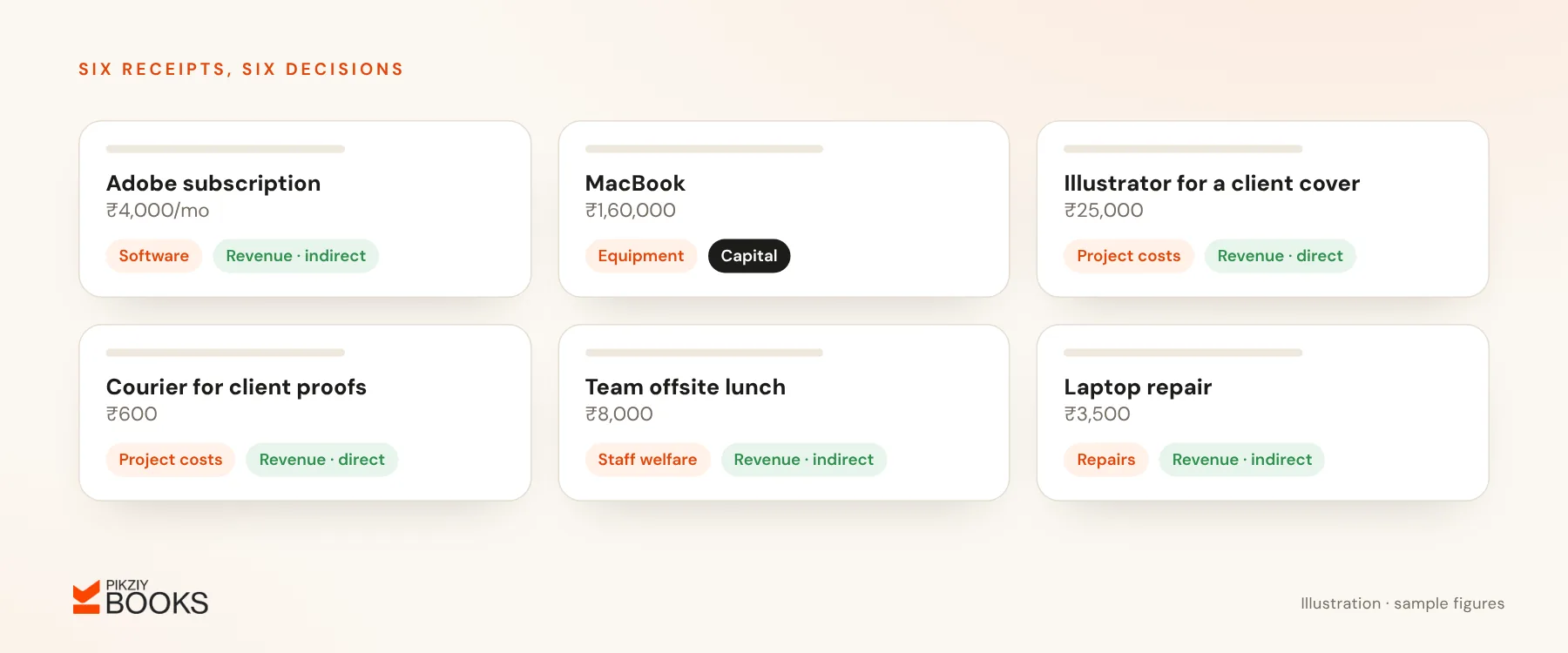
| Adobe subscription, ₹4,000 a month | Revenue | Indirect | Software |
| MacBook, ₹1,60,000 | Capital | — | Equipment (depreciated) |
| Freelance illustrator for a client's book cover, ₹25,000 | Revenue | Direct | Project costs |
| Courier for client proofs, ₹600 | Revenue | Direct | Project costs |
| Team offsite lunch, ₹8,000 | Revenue | Indirect | Staff welfare |
| Laptop repair, ₹3,500 | Revenue | Indirect | Repairs |
The team lunch is also a reminder that GST credit on food and beverages is generally blocked; see input tax credit.
Why correct categories matter
- Accurate profit and margins.
- Correct depreciation and tax treatment.
- Correct GST credit decisions.
- Better budgeting, because you can see where money goes.
Common mistakes
- Expensing a laptop fully in one month.
- Putting the owner's personal spending into business categories.
- Too many categories, used inconsistently.
- A “miscellaneous” category that grows every month.
Frequently asked questions
How many categories should I have?
Is software a capital or revenue expense?
What about my phone and internet bills if I work from home?
Can I change categories later?
Next step
Pick your ten to twenty categories and use the same ones every month. PikZiy Books lets you tag each expense with a category and marks capital purchases as assets, so your P&L and GST credits come out right.