Freelancer vs Sole Proprietor in India: Business and Billing Considerations
Freelancer vs sole proprietor in India: the legal and tax position, which registrations you need and when, how invoicing changes and what records to keep.
Quick answer
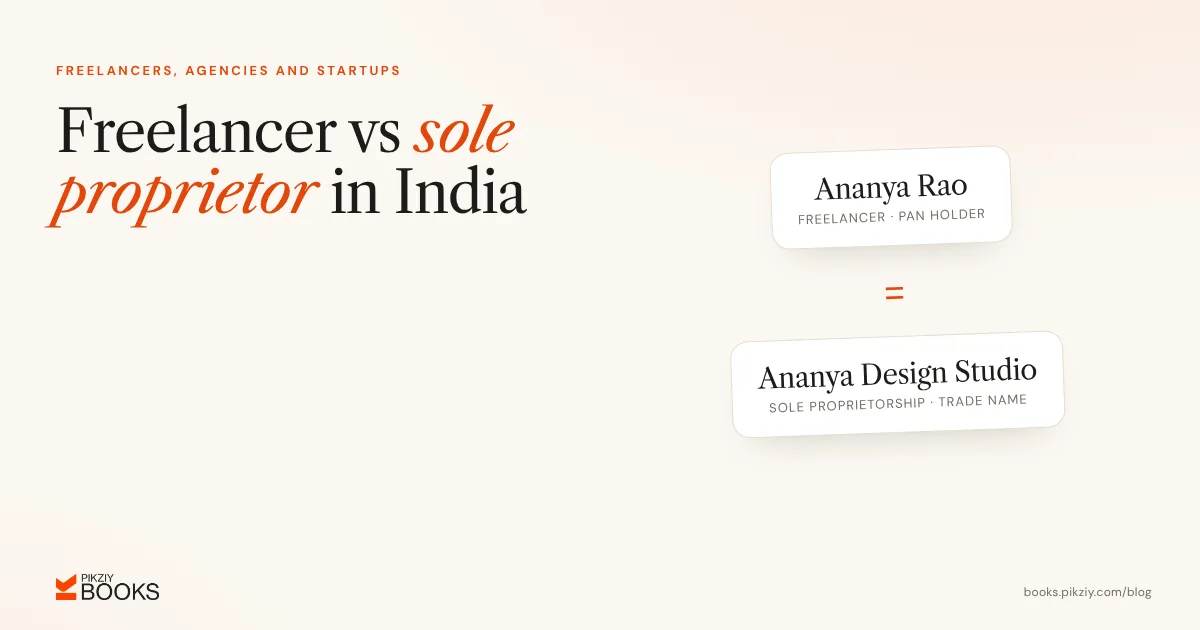
On freelancer vs sole proprietor: in India, a freelancer working under their own name or a trade name, without forming a company, LLP or partnership, is legally a sole proprietor. The business and the person are the same for tax and liability. What changes as you grow is the registrations you hold (GST, Udyam, Shop and Establishment), how formal your invoices and records are, and whether a different structure starts to make sense.
Same legal status, different labels
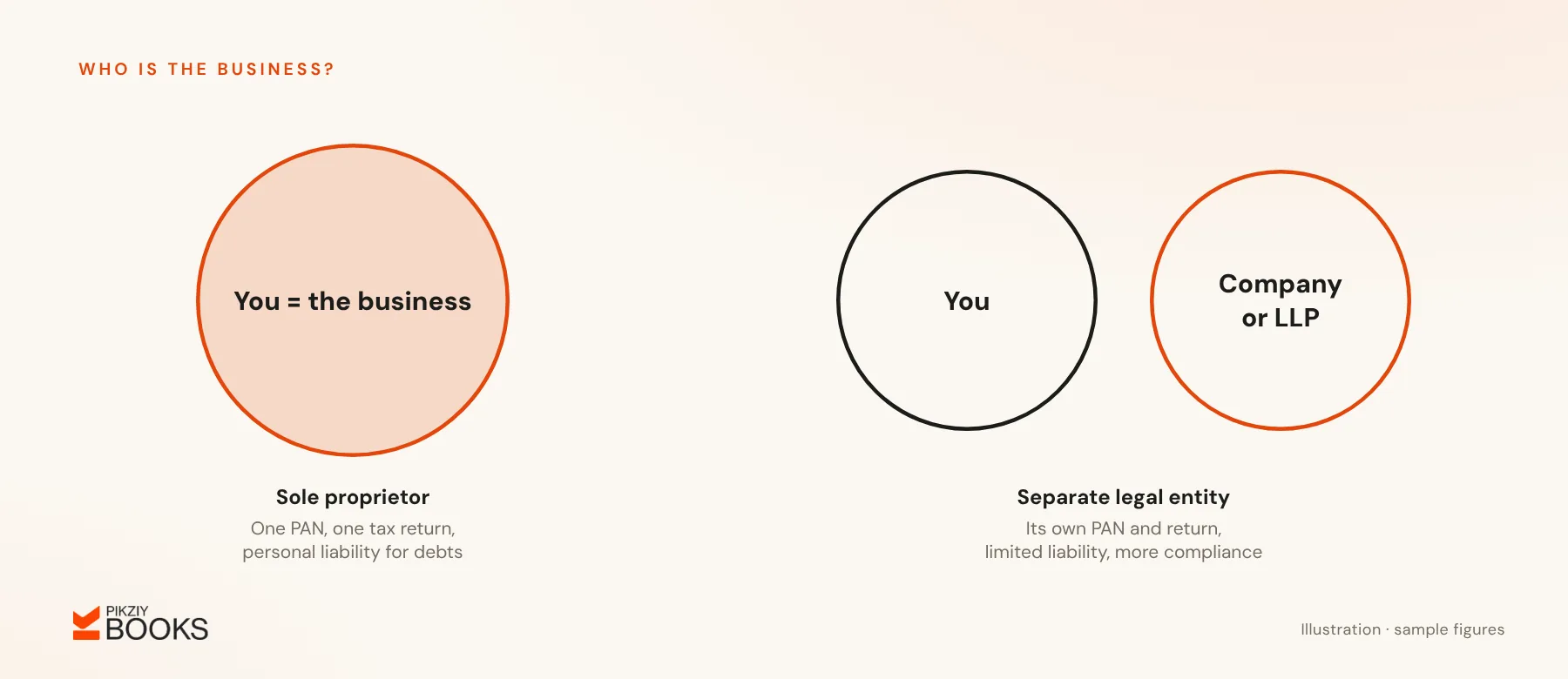
“Freelancer” describes how you work: independently, for several clients. “Sole proprietor” describes the legal form. A freelancer usually is a sole proprietor, unless they have formed an entity. The key points of a sole proprietorship:
- No separate legal entity: the owner's PAN is the business PAN.
- Business income is taxed as the owner's income.
- Unlimited personal liability for business debts.
- No formal registration is needed to exist, though some registrations help.
Registrations to consider
| Registration | When you need it | What it gives you |
|---|---|---|
| GST | Mandatory above ₹20 lakh turnover for services (₹10 lakh in some states); optional below | Lets you charge GST and claim input tax credit |
| Udyam (MSME) | Optional and free | Protection against delayed payments by buyers, and access to some schemes |
| Shop and Establishment | Many states require it once you have premises or employees; rules vary | Proof of the business for banks and landlords |
| Current account in a trade name | When you want one | Banks usually ask for GST, Udyam or Shop Act registration as proof |
Under the MSMED Act, buyers must pay a Udyam-registered micro or small enterprise within the agreed period, and no later than 45 days after accepting the work, or owe compound interest at three times the RBI bank rate. That is a real benefit for freelancers with slow-paying corporate clients. The GST threshold is explained in GST for freelancers.
How invoicing changes
- Name: you can invoice in your own name or a trade name (“Ananya Rao, trading as Ananya Design Studio”).
- PAN: show your PAN so clients can deduct TDS correctly; see TDS on professional fees.
- GST: if registered, your GSTIN is linked to your PAN and trade name, and invoices must follow the GST invoice format.
- Bank account: a current account in the trade name looks more professional to companies.
Taxes
Freelance income is generally taxed as business or professional income in your individual return. Eligible professionals can opt for presumptive taxation (section 58 of the Income-tax Act, 2025, formerly 44ADA), which reduces bookkeeping. Advance tax applies once your tax for the year, after TDS, is ₹10,000 or more.
When to consider another structure
- You want limited liability because of contract size or risk.
- You plan to raise investment or bring in partners.
- Clients prefer to contract with a company.
- Your income is high enough that a company's tax treatment is worth comparing.
An LLP or private limited company adds compliance costs and annual filings, so compare carefully with your CA.
Worked example
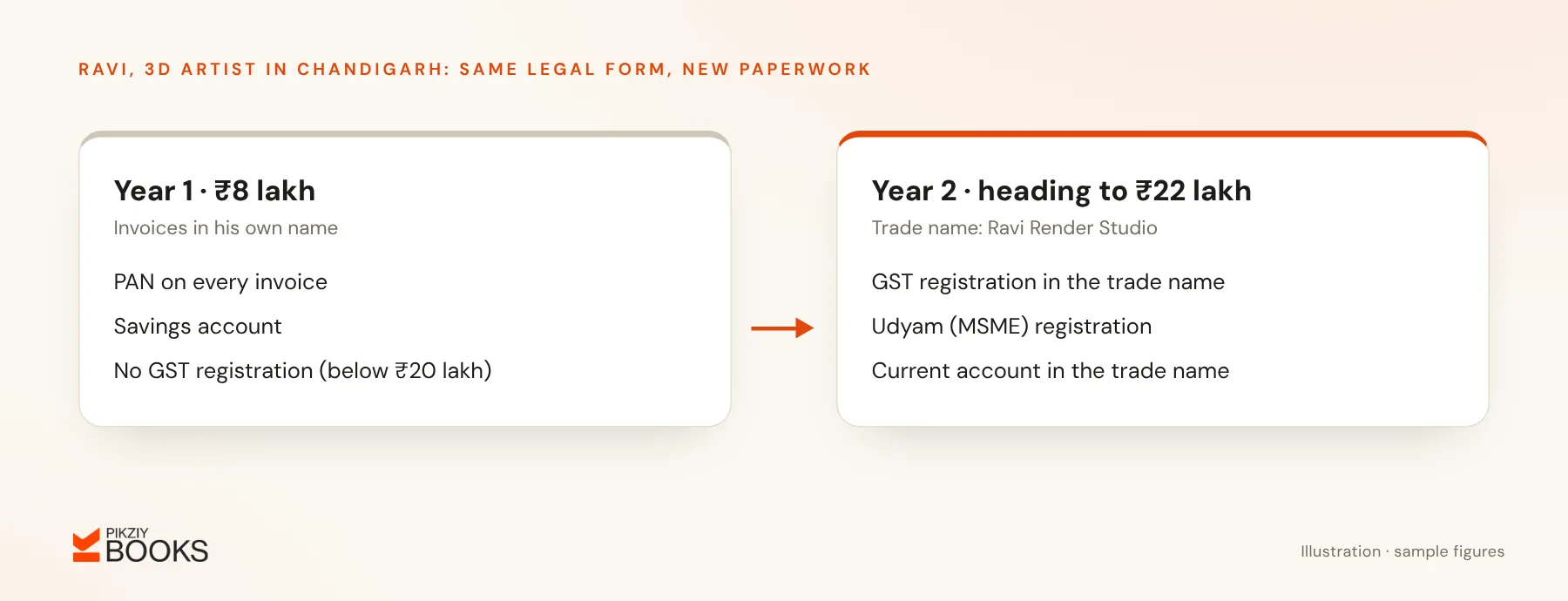
Ravi starts freelancing as a 3D artist in Chandigarh. In year 1, he invoices in his own name and is not GST-registered, receiving ₹8 lakh. In year 2, with receipts heading to ₹22 lakh, he registers for GST under the trade name “Ravi Render Studio”, gets Udyam registration and opens a current account in the trade name. He is a sole proprietor throughout; only his registrations and paperwork changed.
Frequently asked questions
Do I need to register a sole proprietorship?
Can I have employees as a freelancer?
Can I invoice without GST registration?
Is a trade name the same as a registered brand?
Next step
List the registrations you have today and the ones you will need at your next turnover milestone. PikZiy Books keeps your trade name, GSTIN, PAN and bank details consistent on every quotation and invoice.